Your consent banner is working. But is your measurement strategy?
A visitor lands on your website through a paid campaign. They browse several products, compare options and eventually complete a purchase. But before continuing, they decline analytics and advertising cookies. What happens next?
Depending on your implementation, certain tracking technologies may be restricted or behave differently. Some interactions may no longer be observable through conventional measurement methods. Your analytics platform may report fewer conversions. Your advertising platform may attribute less revenue. Your marketing team may conclude that campaign performance is declining.
Yet actual business performance may remain stable. This creates a growing challenge for organizations: how can marketing teams maintain meaningful measurement while respecting customer privacy choices? The answer requires more than installing a consent banner. It requires a coordinated architecture connecting consent management, tagging, analytics, advertising and data governance.
Consent has become an essential component of digital measurement. Organizations operating across multiple jurisdictions must account for different privacy requirements and customer expectations. When users decline optional cookies, organizations cannot simply continue using tracking technologies as if consent had been granted.
However, this does not necessarily mean that all measurement becomes impossible. Depending on the legal framework, implementation and applicable platform requirements, privacy-aware measurement solutions can help organizations understand aggregate performance and model certain missing conversion information.
The challenge is distinguishing between:
These categories must not be confused. A modeled conversion is not the same thing as a directly observed purchase. Understanding these measurement gaps also requires reliable tracking and data quality. Explore how GA4 Tag Diagnostics can help identify implementation issues and strengthen measurement reliability.
Volkswagen Belgium, through D'Ieteren Automotive, encountered an important discrepancy. Marketing performance appeared to decline, while business indicators such as dealership visits and new vehicle sales remained stable or positive. The investigation revealed that increasing numbers of visitors were declining marketing and analytics cookies.
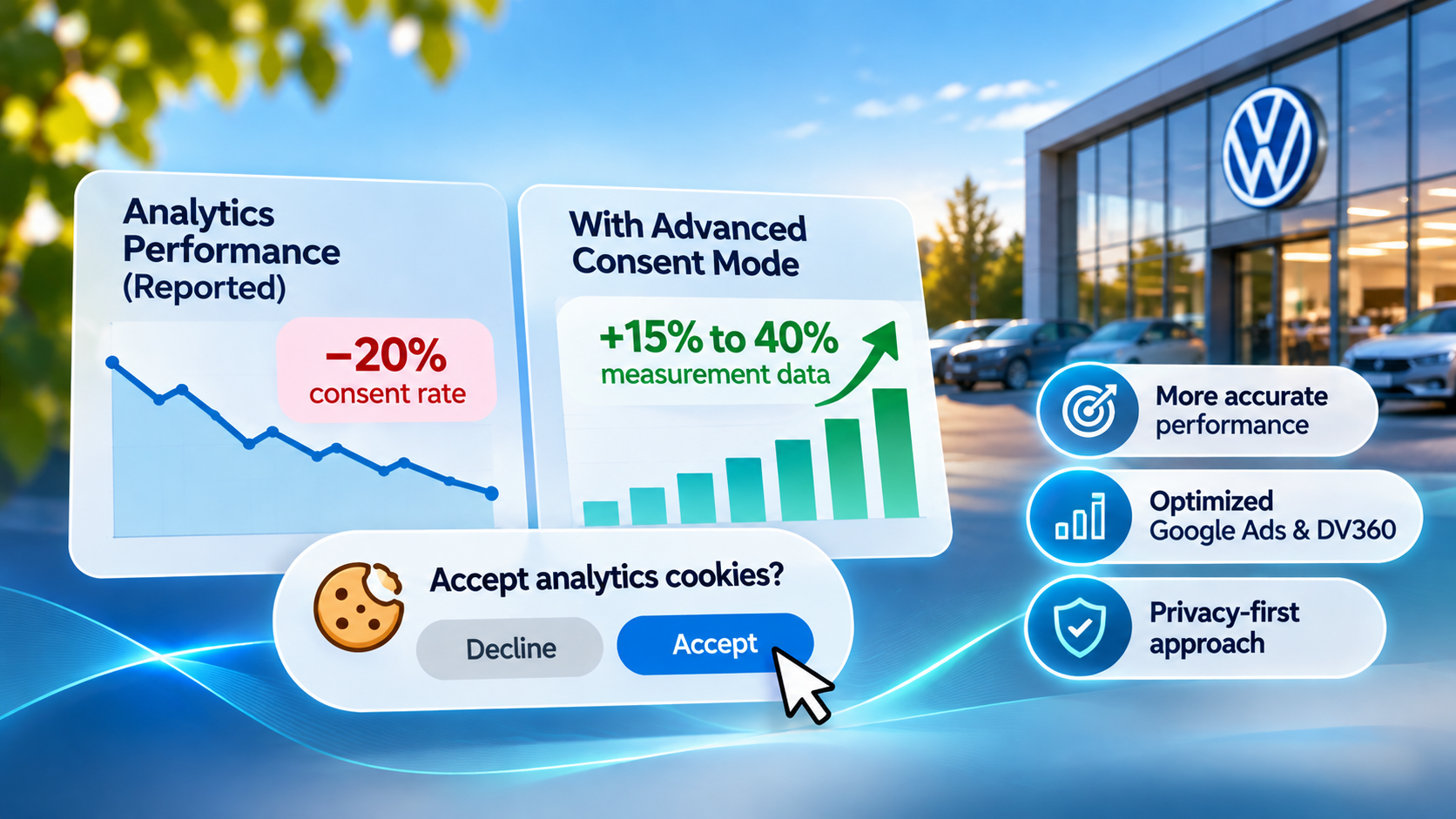
For some brands, consent acceptance rates had declined by 20% over two years. This created a measurement gap between what the analytics platforms reported and what was happening in the business. Volkswagen introduced Advanced Google Consent Mode across its brand portfolio, using Google Tag Manager to manage tag behaviour. Under the implementation described in Google's case study, eligible cookieless signals could be used when users declined cookies, allowing Google to model certain missing measurement information.
The reported outcome was an increase of 15% to 40% in collected measurement data, depending on the brand. The additional signals also helped improve the optimization of Google Ads and Display & Video 360 campaigns. This result is particularly important because the company did not simply need more tracking. It needed a more accurate understanding of performance while respecting privacy choices.
TUI, a global tourism group, faced a related challenge after launching a new website with a cookie consent banner. Visitors could choose whether to accept cookies. When users declined consent, TUI could no longer measure conversions in the same way through conventional cookie-based attribution. The company implemented Google Consent Mode to adjust Google tag behaviour according to users' consent choices.
The implementation also enabled conversion modeling for conversions that could not be directly measured. Following implementation, TUI reported a 7% increase in measured conversions from Google Ads campaigns. The increase reflected improved measurement through modeling, not necessarily a 7% increase in actual sales. This distinction is essential when communicating performance results to executives.
A consent-aware measurement architecture must establish the correct behaviour before analytics and advertising tags execute. The process generally involves four stages.
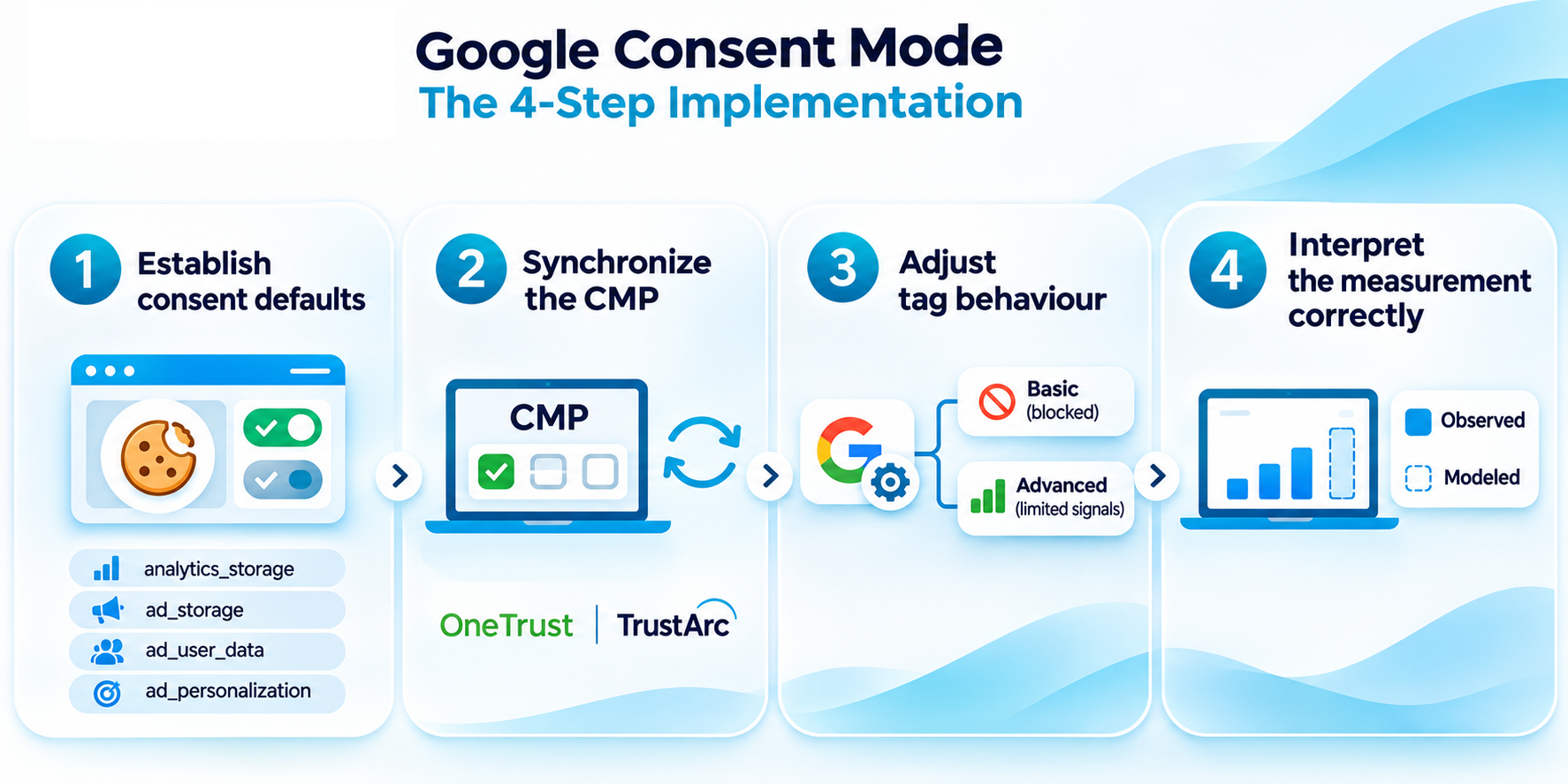
When a visitor first arrives, the website must establish the appropriate default consent states.
For Google implementations, Consent Mode can communicate states such as:
The appropriate defaults depend on the organization's jurisdiction, legal assessment and consent management strategy.
The consent management platform (CMP) communicates the visitor's choices to the tagging infrastructure. Examples include OneTrust and TrustArc. Consent Initialization in Google Tag Manager is particularly important because default consent states must be established before other relevant tags execute.
Google Consent Mode adjusts the behaviour of supported Google tags based on the consent signals received. In Basic Consent Mode, Google tags are blocked until the relevant consent is granted. In Advanced Consent Mode, eligible tags can send limited cookieless signals when consent is denied.
Those signals may support modeling when the applicable requirements and thresholds are met. This does not authorize the collection or use of information that the visitor has declined to provide.
Analytics and advertising platforms may distinguish between observed and modeled information. Reporting environments should preserve this distinction. Organizations should not present modeled conversions as if every conversion had been directly observed.
The following simplified example illustrates how Google Consent Mode can establish default states and receive a subsequent consent update. It is an implementation illustration, not a complete production-ready CMP integration.
// Establish consent defaults before Google tags execute
gtag('consent', 'default', {
  analytics_storage: 'denied',
  ad_storage: 'denied',
  ad_user_data: 'denied',
  ad_personalization: 'denied',
  wait_for_update: 500
});

// Example: update after the CMP confirms
// that the visitor has granted the relevant consent
gtag('consent', 'update', {
  analytics_storage: 'granted',
  ad_storage: 'granted',
  ad_user_data: 'granted',
  ad_personalization: 'granted'
});
In a real implementation, the update must reflect the actual choices made by the visitor. It must not automatically grant every consent category. The organization must also verify that the CMP, Google Tag Manager and relevant tags communicate consistently.
Consent Mode is a Google measurement solution. It should not be treated as a universal consent mechanism for every analytics platform. Organizations using Adobe Analytics must also configure their Adobe implementation according to the applicable consent requirements.
Depending on the architecture, this may involve:
For organizations using both Adobe Analytics and GA4, consent governance must be coordinated across the entire measurement ecosystem. A visitor's consent choice should not be interpreted differently simply because multiple analytics technologies are installed on the same website.
A consent banner can function correctly while the underlying measurement architecture remains inconsistent. That is why validation must extend beyond the visible interface.
1. Initial consent state
Verify that default consent settings are established before relevant tags execute.
2. Consent acceptance
Confirm that the appropriate tags respond correctly when a visitor grants consent.
3. Consent rejection
Verify that tags do not perform prohibited storage or access operations.
4. Consent withdrawal
Test whether subsequent tag behaviour reflects a visitor changing their preferences.
5. Cross-platform consistency
Compare the behaviour of GA4, Google Ads and Adobe Analytics.
6. Measurement validation
Distinguish directly observed conversions from modeled conversions.
7. Documentation
Maintain evidence of configurations, testing results, consent rules and changes.
One of the most common misconceptions is that implementing a consent management platform or Google Consent Mode automatically makes a website compliant. It does not. Technology supports compliance, but the organization remains responsible for its legal and operational obligations.
Depending on the markets in which it operates, this may include:
A proper governance framework must consider legal basis, consent requirements, data minimization, purpose limitation and the organization's overall data practices.
Privacy-aware measurement should be designed around the rights and expectations of visitors, not simply around recovering missing marketing data.
Privacy and analytics should not operate as separate initiatives. A reliable measurement strategy must connect consent management, tag governance, analytics configuration and advertising measurement. Volkswagen and TUI demonstrate that privacy-aware measurement can improve the visibility of marketing performance without treating consent as an obstacle to bypass.
For organizations using Adobe Analytics, GA4, Google Tag Manager and enterprise CMP platforms, the opportunity is to establish a consistent architecture that protects customer choices while preserving the integrity of business insights. The objective is not to measure everything. It is to understand what can be measured, why it can be measured and how much confidence organizations should place in the results.
Sources
Google — Shifting Gears with Consent Mode – Volkswagen Belgium Case Study
Google — TUI Measures 7% More Conversions with Consent Mode
Google for Developers — Consent Mode Overview – Basic vs. Advanced Implementation
Google Tag Manager — Consent Mode Support and Configuration
Google for Developers — Set Up Consent Mode on Websites
Adobe Experience League — Consent Configuration Settings – Adobe Experience Platform Web SDK
Adobe Experience League — Processing Customer Consent Data Using the Adobe Experience Platform Web SDK
Adobe Experience League — Set Up Consent with Platform Web SDK
European Data Protection Board — Guidelines 05/2020 on Consent Under GDPR
California Privacy Protection Agency — CCPA Laws and Regulations
Commission d’accès à l’information du Québec — Principaux changements apportés par la Loi 25
Éditeur officiel du Québec — Act Respecting the Protection of Personal Information in the Private Sector