
October 2026 marks an important evolution in Adobe Analytics. Artificial intelligence, improved governance, and more intuitive reporting capabilities are changing how organizations explore and interpret their marketing data. The biggest shift is not simply faster reporting. It is reducing the distance between identifying a performance change and understanding what contributed to it.
Imagine a marketing team discovering an unexpected decline in campaign conversions. Instead of manually navigating multiple reports, comparing segments, and rebuilding visualizations, AI-powered capabilities can help identify the dimensions and segments contributing to the change. For marketing leaders, analysts, developers, and MarTech managers, these developments create new opportunities to simplify analytics operations and improve decision-making.
Here are the seven developments worth watching.
October 29, 2026 | General Availability
One of October's most significant updates is the expansion of Adobe CX Enterprise Coworker Chat. Users can now explore Adobe Analytics report suite data through natural-language prompts and investigate Martech performance changes that previously required more manual work in Analysis Workspace. The new root cause analysis capability can surface dimensions and segments contributing to a metric change.
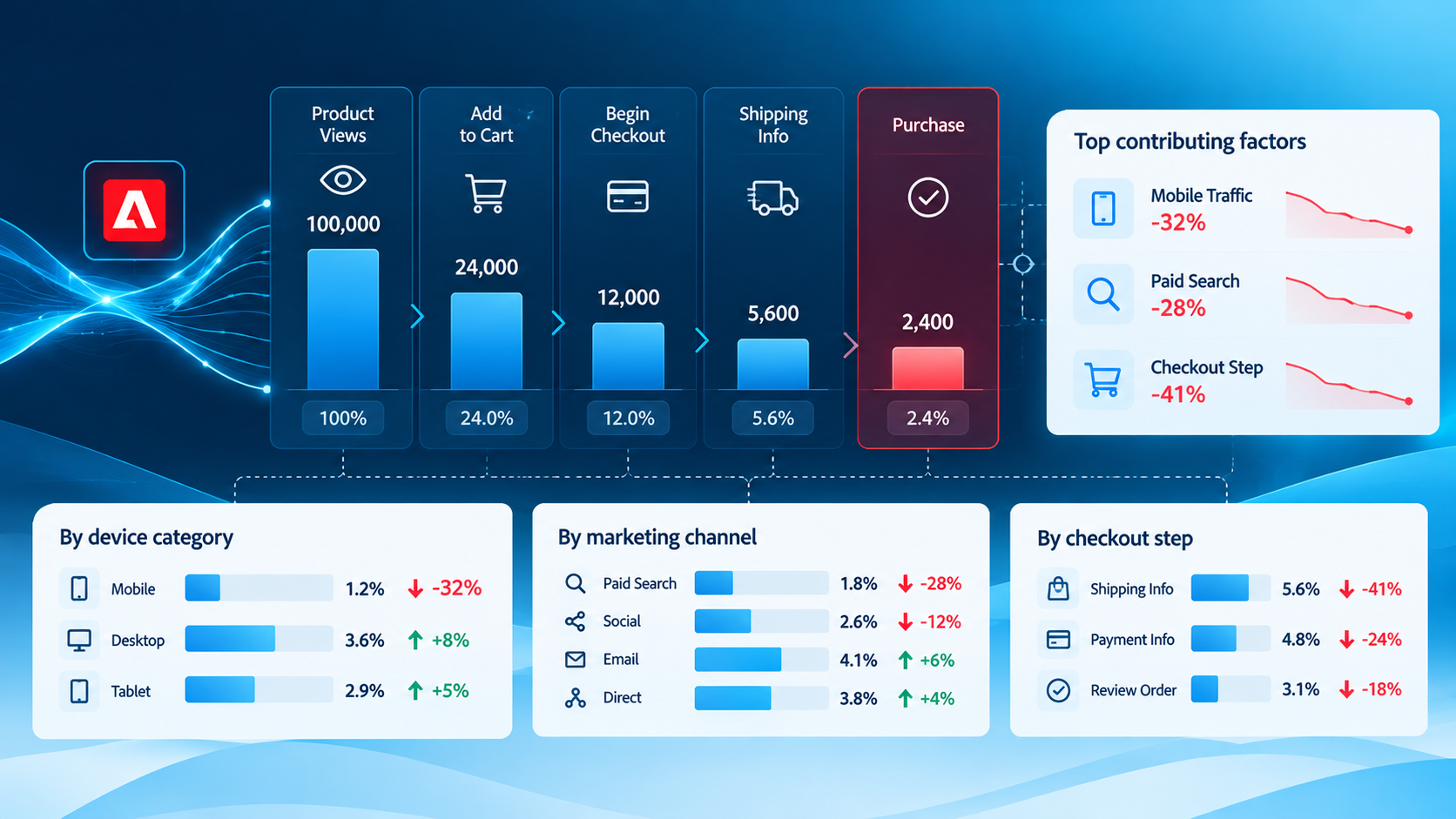
An e-commerce company notices that its online conversion rate has dropped from 3.2% to 2.4% compared with the previous week. The marketing team needs to understand what happened before reallocating campaign budgets or changing the customer experience.
The analyst submits a natural-language prompt:
"Why did our conversion rate decrease last week, and which dimensions and segments contributed most to the decline?"
Using Adobe Analytics report suite data, Coworker Chat investigates the metric change and surfaces contributing dimensions and segments.
For example, the investigation might highlight:
These are illustrative findings, not actual results from a customer account.
The analyst opens the generated visualization in Analysis Workspace to:
The MarTech team can prioritize a mobile checkout investigation, review campaign landing pages, and assess whether the conversion decline is related to traffic quality or user experience.
Traditional analytics helps teams identify performance changes. Adobe's new AI-powered root cause analysis helps accelerate the investigation into what contributed to those changes. For organizations, this means less time searching through reports and more time validating insights and identifying optimization opportunities.
MarTech perspective: AI can accelerate analytics investigations, but reliable results still depend on a well-structured measurement architecture, consistent event tracking, and meaningful segmentation.
October 6, 2026 | General Availability
Adobe introduced a dedicated read-only permission for its Model Context Protocol (MCP) server.
The update separates two access levels:
Previously, the MCP Access permission provided access to both read and write capabilities. The new structure gives administrators more control over how connected AI applications interact with Adobe Analytics.
- Why it matters: Organizations can explore AI-connected analytics workflows without automatically granting permission to modify their analytics environment.
- MarTech Insight: Review MCP permissions, product profiles, and existing administrative roles before introducing AI-connected workflows. Read-only access should be part of a broader governance strategy, not treated as a complete security solution.
October 19–29, 2026
Adobe introduced three improvements that make analytics easier to interpret.
The Journey Canvas comparison option displays changes in percentage points across journey nodes, arrows, and fallout. This is particularly useful when comparing conversion or retention rates between periods with different audience volumes. Concise Visualization Labels remove repetitive information from legends, making differences between metrics and segments easier to identify. Automatic Component Descriptions will also help users understand dimensions, metrics, calculated metrics, segments, and date ranges.
Availability note: Automatic descriptions were announced October 29, with general availability scheduled for November 18, 2026.
MarTech Insight: Reporting complexity often comes from inconsistent naming conventions, undocumented metrics, and poorly structured component libraries. Improving these foundations can make an analytics environment easier to maintain and use.
October 14, 2026 | General Availability planned for January 2027
Adobe announced improvements to classification data accuracy in Data Warehouse reports.
Two changes deserve attention:
For organizations relying on campaign classifications, product hierarchies, and custom metadata, these changes can improve reporting accuracy.
MarTech Insight: Classification quality directly influences how organizations organize and interpret marketing data. Review classification structures and validate important reports when the improvements become available.
October 29, 2026 | General Availability
Adobe introduced the ability to migrate Adobe Analytics projects and associated components to Customer Journey Analytics through CX Enterprise Coworker. The workflow validates whether project dimensions and metrics are mapped to the destination data view, helps resolve missing mappings, and recreates the project in Customer Journey Analytics. Users with the required Component migration permission can perform these migrations without necessarily being administrators.
Why it matters: Organizations planning their transition to Customer Journey Analytics can reduce manual migration work and improve workflow efficiency.
MarTech Insight: Migration should also be an opportunity to review measurement architecture. Moving an inefficient analytics structure to a new platform does not automatically make it better.
October 2026 | Availability to be confirmed
Adobe announced an integration between Adobe Brand Visibility and organizational Adobe Analytics data. The objective is to measure how AI-driven discovery translates into actual website engagement and business outcomes. This is an important direction for organizations evaluating how AI-powered search and discovery influence the customer journey. However, Adobe's October release notes still list the availability as TBD. It should therefore be considered an announced development rather than a generally available feature.
MarTech Insight: As discovery evolves, organizations will need measurement strategies that connect emerging acquisition experiences to meaningful website engagement and business outcomes.
October's Adobe Analytics releases reveal a clear shift in how organizations access, interpret, and act on their data. Seven developments illustrate this evolution across AI, governance, reporting, and data management.
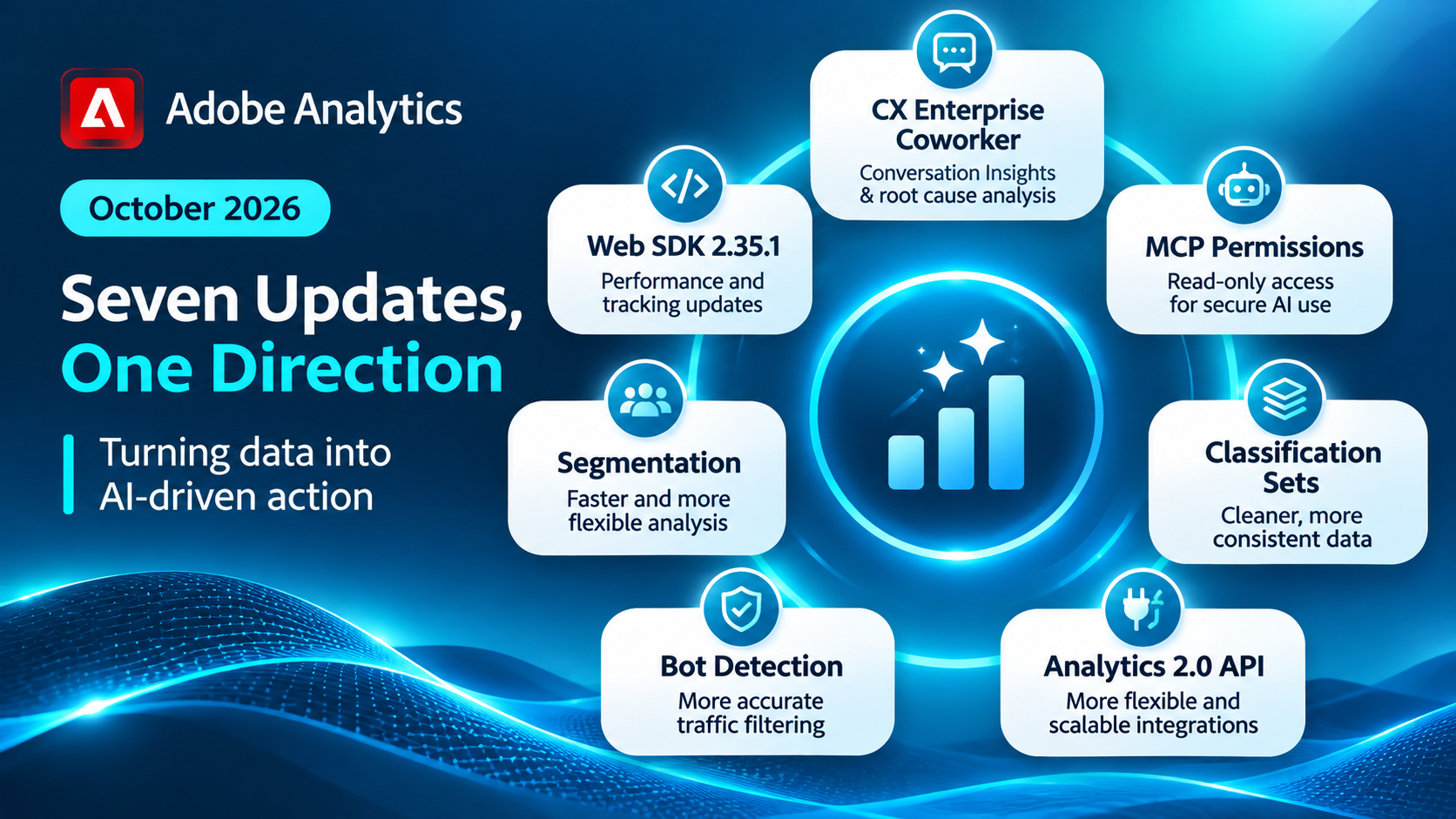
Together, these updates point to a more connected and intelligent analytics ecosystem. The opportunity for organizations is to move beyond collecting and reporting data toward simplifying workflows, accelerating investigations, and making better-informed decisions.
October's updates create an opportunity to reassess how Adobe Analytics supports everyday marketing operations.
Three priorities stand out:
These priorities are closely connected to the broader challenge of MarTech simplification. Organizations looking to reduce reporting friction, standardize measurement, and improve their analytics architecture can explore Devrun's MarTech simplicity service. The objective is not to add more technology. It is to make existing MarTech investments easier to manage and more effective.
Adobe Analytics October 2026 updates demonstrate a clear evolution toward more intelligent, accessible, and governed analytics workflows. AI-powered investigations, granular permissions, cleaner visualizations, and improved data management are helping MarTech organizations move beyond traditional reporting. But technology alone does not eliminate complexity. The real advantage comes from combining these capabilities with a reliable measurement strategy, structured data foundations, and well-managed MarTech operations.
Less time navigating complexity. More time understanding performance. Better decisions powered by analytics.

What are the major Adobe Analytics October 2026 updates?
The major developments include AI-powered root cause analysis, MCP read-only permissions, Journey Canvas percentage comparisons, concise visualization labels, automatic component descriptions, Data Warehouse classification improvements, and Customer Journey Analytics migration through Coworker.
How does AI improve Adobe Analytics?
Adobe CX Enterprise Coworker Chat enables natural-language exploration of report suite data, investigation of metric changes, and the creation of visualizations that can be opened in Analysis Workspace.
What is Adobe Analytics MCP Read-only Access?
It allows connected applications to access read-only MCP tools without granting permission to create, modify, or delete analytics components.
How can organizations simplify Adobe Analytics?
By standardizing measurement components, documenting metrics and dimensions, reviewing permissions, improving classifications, and reducing unnecessary complexity across their MarTech stack.
Who benefits from the October 2026 Adobe Analytics updates?
Marketing executives, analytics professionals, developers, and MarTech managers can benefit from improved investigation workflows, more controlled access, clearer reporting, and better data management.
Adobe Analytics – October 2026 Release Notes
Adobe Analytics MCP Server – Changelog
Adobe Analytics MCP – Permissions Documentation
Adobe CX Enterprise Coworker – Analyze Adobe Analytics Data
Adobe Analytics – Technical Documentation Updates
Adobe Experience Cloud – Central Release Notes
Adobe Experience League – Analyze data with Coworker Chat