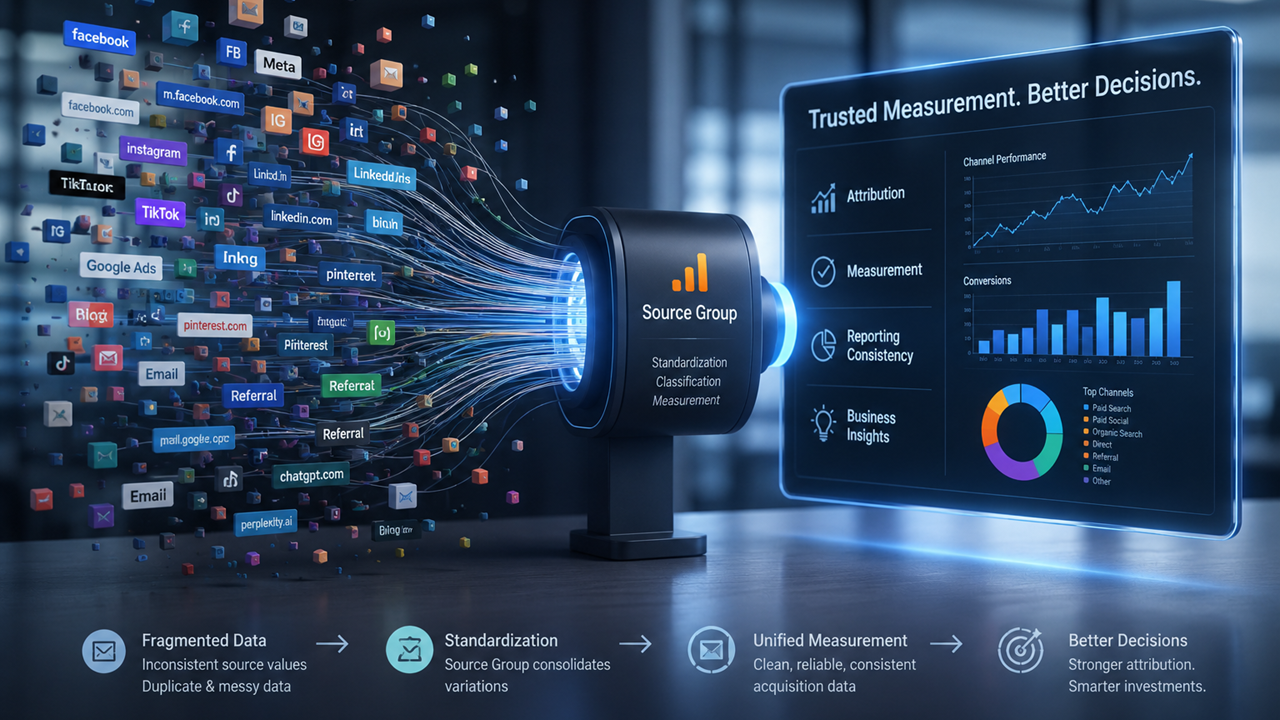
Every day, marketing leaders invest thousands, or even millions, of dollars across Google Ads, Meta, LinkedIn, TikTok, email, affiliates, influencers, and organic search. Yet when quarterly performance reviews begin, many teams still ask the same question:
"Which channels actually drove results?"
Surprisingly, the answer is often less clear than expected. Google Analytics' June 2026 updates don't introduce another dashboard or AI-generated report. Instead, they address something far more valuable: the accuracy and consistency of acquisition data. That improvement may appear subtle, but its impact extends to attribution, budget allocation, executive reporting, and marketing confidence.
Most attribution problems don't begin inside Google Analytics. They begin long before the data reaches your reports. Different teams create different UTM naming conventions. Agencies use their own campaign structures. Advertising platforms generate inconsistent source values. Over time, acquisition reports become fragmented.

A single platform can appear as:
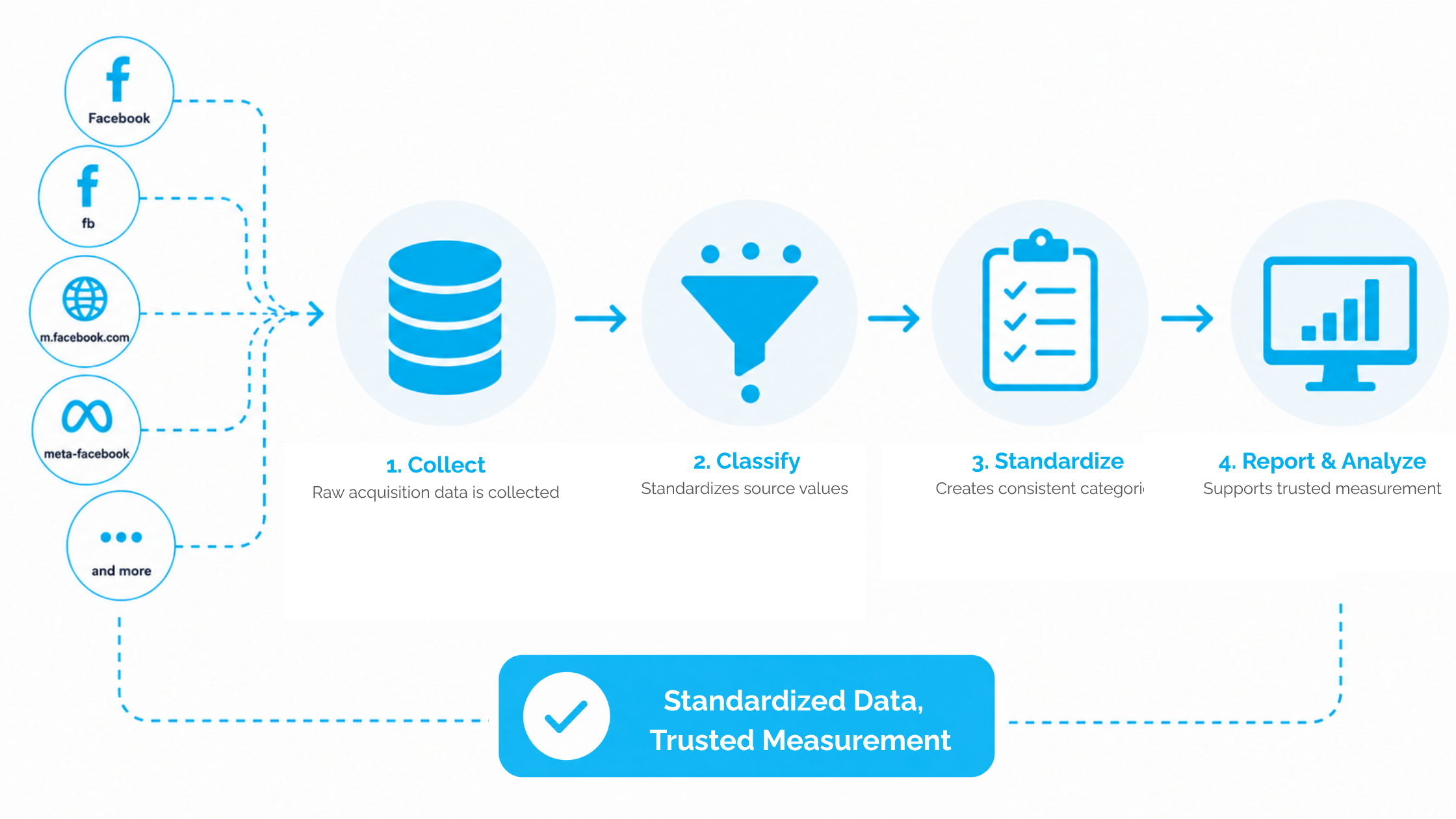
Although each represents the same marketing platform, Google Analytics stores acquisition data using the exact values received through utm_source, referring domains, and campaign metadata. Variations such as facebook, fb, m.facebook.com, or meta-facebook are interpreted as unique source values unless normalized through reporting rules or standardized classifications. This fragmentation affects first-touch and session acquisition reports, complicates cross-channel analysis, and introduces unnecessary noise into attribution models, especially in organizations managing hundreds of concurrent campaigns.
Google Analytics does not "understand" that facebook, fb, and m.facebook.com refer to the same marketing platform. It stores and reports exactly what it receives. Source Group improves how these values are classified for reporting, it does not modify the original acquisition data collected by Google Analytics. Consistent UTM governance and standardized source classification remain essential for reliable acquisition reporting, even with Google's new Source Group improvements.

Source Group improves how acquisition sources are classified, but it doesn't replace good measurement practices. Organizations still need consistent UTM naming conventions, proper consent implementation, accurate campaign tagging, and well-defined attribution strategies to produce reliable marketing insights.
These improvements build on Google's May 2026 GA4 updates, which focused on strengthening data quality, measurement reliability, and campaign analysis, continuing a broader effort to improve marketing measurement
On June 11, Google introduced GA4 Source Group, a new reporting dimension that automatically consolidates multiple source variations into standardized values. Instead of manually cleaning acquisition reports, marketers can now analyze consistent source categories across Google, Meta, TikTok, Pinterest, Amazon, ChatGPT, Perplexity, and other platforms. Google also updated GA4 Source Platform to improve reporting consistency across advertising platforms and support more accurate acquisition analysis as new traffic sources emerge.
As Google explains, GA4 Source Group provides a standardized view of acquisition sources to improve reporting consistency across traffic acquisition reports. Google Analytics processes acquisition data through multiple measurement layers. Raw acquisition values are first collected, then classified into reporting dimensions before they're surfaced in reports and attribution analysis.
The following workflow illustrates how Google's new Source Group standardizes fragmented acquisition values before they reach reporting. By reducing source variability at the classification layer, organizations can improve attribution consistency and produce more reliable cross-channel performance analysis.
Marketing teams often spend hours cleaning reports before they can begin analyzing MarTech performance. Google's new Source Group shifts that effort away from manual normalization and toward business analysis.
Instead of asking: "Why do we have five Facebook sources?" Teams can finally ask: "Which campaign generated the highest return?" That distinction matters. The fastest-growing organizations aren't necessarily collecting more data than everyone else. They're simply spending less time preparing it.
Google's June updates improve the quality of acquisition reporting in multiple ways. While each enhancement appears incremental on its own, together they strengthen the foundation of attribution, reporting consistency, and marketing decision-making.
Together, these MarTech updates demonstrate a broader shift in Google Analytics: improving the quality of measurement rather than simply adding new reporting features.
Google's June 8 release introduced another significant enhancement: Google Business Profile integration directly inside Google Analytics.

Organizations can now combine website engagement with valuable local interaction metrics such as:
For retailers, healthcare providers, restaurants, automotive dealerships, and service businesses, this creates a much clearer picture of how Search and Maps contribute to customer acquisition, not just online conversions.
This also improves first-party measurement. Rather than evaluating website sessions in isolation, organizations can analyze Google Business Profile interactions alongside on-site engagement, strengthening marketing measurement across the entire customer journey.
To maximize the value of Ga4 latest updates, marketing teams should focus on these four priorities;
Google's updates improve the quality of acquisition reporting. They don't automatically improve measurement maturity. Organizations still need standardized campaign governance, privacy-compliant implementations, attribution strategies, and executive dashboards that support confident business decisions.
Organizations that combine high-quality analytics with strong governance, privacy-compliant implementations, and actionable reporting are better positioned to make faster, more confident marketing decisions.
Google's June 2026 updates strengthen the foundation of acquisition reporting, making it easier to understand performance, evaluate marketing investments, and make MarTech decisions with greater confidence.